160+ reviews

Everyone wants that snowy Lofoten summit photo — the dramatic views, the white peaks, and the cotton candy sky everyone posts on Instagram. But not everyone makes it to the top — and those who do don’t always come back with dry feet, warm fingers, or the desire to ever go winter hiking again.
While guiding winter trips to Ryten, we’ve seen it all: frozen toes, soaked jeans, people sliding down on their backsides, and others trying to find their way in the dark with a phone flashlight. It’s funny until it isn’t.
Winter hiking in Lofoten is tough, unpredictable, and sometimes flat-out dangerous. This isn’t meant to scare you — it’s meant to prepare you. In this guide, we’ll give you the unfiltered truth about what winter hiking here is really like: the weather, the daylight, avalanches, equipment, trail conditions, and finally the mountains themselves. Which ones are possible, which ones are risky, and which ones are an absolute no-go.
Let’s start with the biggest misconception: visiting Lofoten between October and March does not mean you’ll be walking through a winter wonderland with guaranteed snow. Sorry to disappoint, but that’s not how it works here.
Lofoten sits right in the middle of the Gulf Stream, which means our climate is mild compared to other places on the same latitude. In practice, this means that winter temperatures usually hover around 0°C—sometimes a few degrees above, sometimes a few below.
So what happens? This:
Sometimes these changes happen over weeks. Other times you get all of it in just a couple of days—or even in a single day.
The result? Hiking conditions are impossible to predict long in advance. A mountain where you might have needed snowshoes three days ago may require crampons today. A slope that was avalanche-safe last week might be dangerous now. The same trail can be a pleasant walk on one day, and nearly impossible the next.
So when you ask me in December: “What will the trail to Ryten be like in February?”—the honest answer is: I don’t know. Nobody knows. You’ll only know once you’re here, checking the latest conditions and forecasts.
Do we understand each other?
Another thing people often underestimate in Lofoten winter: daylight.
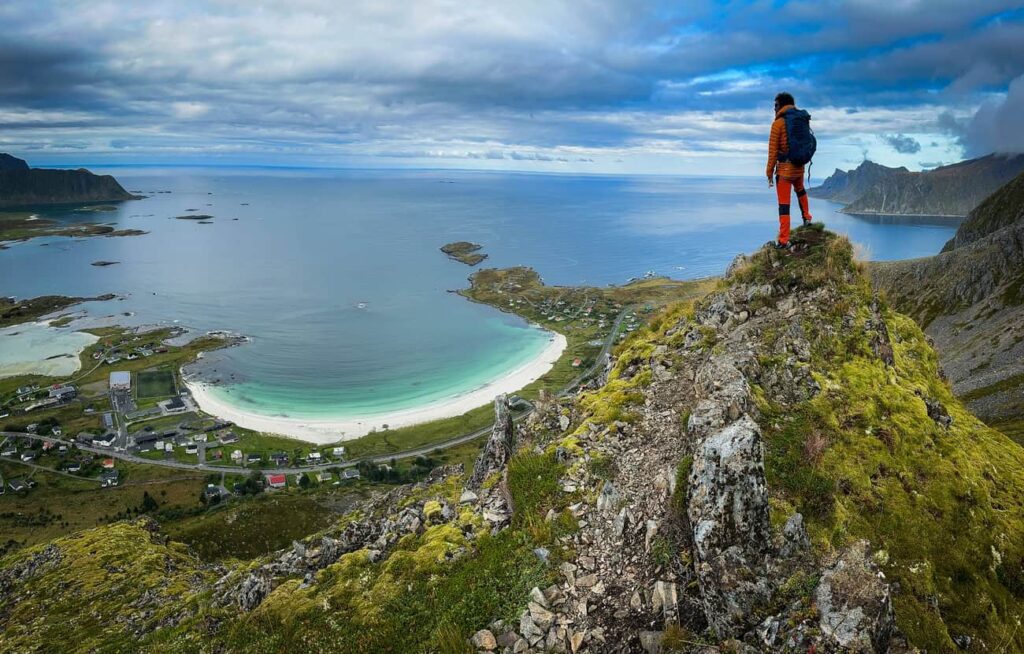
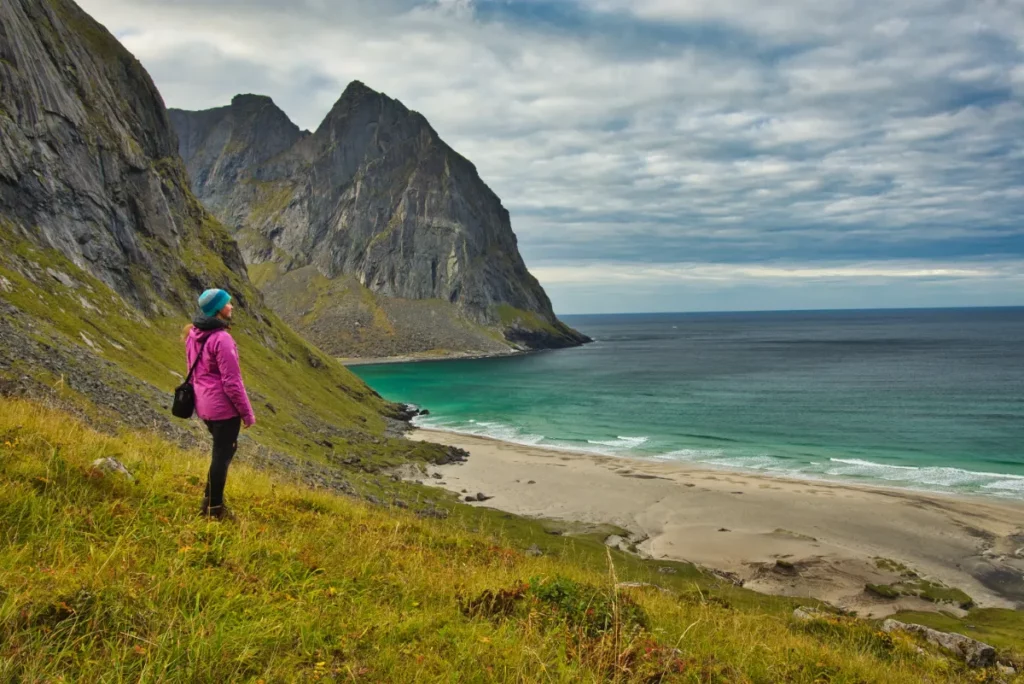
Let’s take Ryten as an example. Ryten is one of the locals’ winter favorites thanks to its moderate slope (not avalanche-prone) and those jaw-dropping views over Kvalvika Beach. It’s also the mountain we guide most often in winter—we’re up there one to four times a week—so trust me, we know what it takes.
In winter, you should expect about 3 hours up to the summit (depending on your fitness, weather, and snow conditions), and another 2 hours down. That’s already a five-hour round trip.
This means two things:
And then there’s the Lofoten weather. Whiteouts are common here. Whiteouts in darkness? That’s a nightmare scenario, especially if you don’t know the terrain and the trail is covered by snow.
So here’s the brutal truth: you need to keep track of time. If you’re too slow, if the weather turns, or if daylight is running out—turn around. The mountain isn’t going anywhere.
Now let’s talk about something serious: avalanches.
The mountains in Lofoten are steep. Like really steep. Many of them are completely unclimbable even in summer—so you can imagine what they’re like when covered in snow and ice in winter.
Here’s a simple rule of thumb: any slope steeper than about 30° is avalanche terrain. That means if you’re looking up at a mountain and it looks steep… well, chances are it is steep enough to trigger avalanches.
This is why you can’t just pick any random peak on a map and decide to “go for a winter hike.” The terrain here doesn’t work like that. You need to carefully choose mountains that are safe for winter hiking.
You’ve basically got two options:
Avalanches here are not some theoretical danger—they happen every winter (and spring!!!), and they are deadly. So don’t gamble with your life for a photo. Choose wisely.
Let me set your expectations straight: even in summer, hiking in Lofoten is not like hiking in the Alps or in North America. Our trails are rough, rocky, and often steep. Trail marking is minimal to non-existent. There are no mountain huts, no staffed cabins, no prepared trails, no “trail guardians.” In winter, all of this gets amplified.
Sometimes you’re lucky and there’s a track from hikers before you. Sometimes there isn’t, and you’ll be the one plowing through knee-deep snow. Even on Ryten—the most popular winter hike in western Lofoten—we often end up breaking the trail, because we’re usually the first ones to head up in the morning.
And here’s the catch: just because there’s a track doesn’t mean it’s the right one. We know where to go, but imagine you’re blindly following footprints left by someone who had no idea what they were doing. You can easily get yourself into trouble that way.
Another important point: winter trails don’t always follow summer trails. Ryten is again the perfect example.
But here’s the problem: your average hiking app or summer map doesn’t show that winter alternative. Which is exactly how people end up in the wrong place when the terrain is covered in snow.
So, bottom line: don’t blindly trust maps or footprints. Winter conditions change the game completely, and you need to adjust your expectations accordingly.
As I wrote earlier about the changeable weather: you can’t just head into the mountains in Lofoten in winter with regular hiking boots and optimism. Without the right equipment, you’ll either exhaust yourself, end up on your butt, or put yourself in real danger.
The basics you need to think about are snowshoes, microspikes, crampons, hiking poles, and a headlamp.
So, when do you use what? It depends entirely on the terrain and the snow or ice conditions on that day:
Use snowshoes when there’s deep, soft snow. Without them, every step you take will sink down, and hiking becomes an energy-draining nightmare. Snowshoes spread your weight over a bigger surface and make it possible to move forward without burning out after 200 meters.
And by microspikes I mean real mountain hiking microspikes—not those flimsy plastic ones you find online. Those are a joke. They don’t give you the traction you need, they break easily, and when the little plastic teeth fall off, we end up picking them up from the trail later. They’re bad for the environment and worse for your safety.
Proper microspikes for mountain hiking are made with steel chains and teeth. These are what you’ll use for most winter hikes in Lofoten, because ice is everywhere—from frozen ground to steep, slippery sections. If you take one piece of advice from me, let it be this: bring good microspikes.
Think of crampons as microspikes on steroids. They’re meant for serious climbing expeditions, steep ice, and technical mountaineering. Unless you already know how to use crampons, you don’t need them. In fact, if you’re new to winter hiking, you’ll most likely injure yourself trying. Just acknowledge they exist and leave them to the climbers.
Poles can be really handy in winter—they help you keep balance, especially on descents or when crossing icy sections. Whether you use them or not is up to personal preference, but here’s what usually happens on our guided tours: in the beginning, people are like “nah, I don’t need poles.” Then, on the way down, suddenly everyone wants one of the extra pairs we carry. Trust me, they make life a lot easier.
We’ve talked about daylight hours already, but let me say it again: a headlamp is non-negotiable in the dark months. From November through early February you will need one—it’s pitch dark before you know it. By March and April you might get away without it, but in mid-winter, it’s a must. And not just any headlamp: a powerful one, fully charged before you leave. Do not rely on your phone flashlight. Please.
Last but not least, let’s talk about clothing. I’ll keep this brief, because honestly, I could write a whole book about how to dress for winter hiking in Lofoten. But here are some of the biggest audacities we’ve actually seen out there—either on our own clients, or on random people we’ve met on the trail:
So, what should you actually wear?
Think in layers so you can regulate your body temperature as you move. You’ll warm up fast going uphill, and cool down just as fast when you stop. The trick is to avoid sweating too much, because once you’re wet, the cold will hit you hard.
Skip the planning and let us show you around. Join one of these small group tours.
Now that we’ve set the stage with weather, daylight, avalanches, trails, equipment, and clothes, let’s get down to business.
Here are some of the most common mountains people ask about in winter, and our honest take on each of them.
If there’s one mountain that actually works in winter, it’s Ryten. The slope is moderate, avalanche risk is low compared to other peaks, and the view over Kvalvika Beach is unbeatable. For many locals, this is the go-to winter hike — and it’s also the one we guide most often.
We’re on Ryten one to four times a week throughout the winter with our guided groups, so we know the conditions there well. If you want to experience a proper winter hike in Lofoten safely, join one of our guided tours to Ryten — it’s challenging enough to be memorable, but not so extreme that you won’t enjoy it.
Røren sits above Fredvang, overlooking the Innersand beach. The hike itself isn’t extremely long, but it is steep, so don’t underestimate it: parts of the slope are avalanche terrain, and in icy conditions the exposed sections can feel sketchy.
On a good day it’s a rewarding viewpoint for less effort than Ryten, but only go if you know how to evaluate avalanche danger, and you’re comfortable with winter conditions.
This one is simple: Reinebringen is a NO GO in winter. The famous staircase is steep, icy, and avalanche-prone. People ask every year if it’s possible — and every year, the answer is the same: don’t do it.
Sometimes people ask if we can guide them up to Reinebringen in winter. Technically, yes — we have the gear and the experience for it. But in reality? Doing that would be social suicide here in the local community. So the answer is no.
If you want a proper winter hike, join us on Ryten instead. We’ll get you safely up and down, and you’ll actually live to tell the tale about it.
The summer hike to Munkebu hut from Sørvågen is already long. In winter, it becomes a serious undertaking: steep terrain in several places, deep snow that slows you down, and tricky navigation if visibility is poor.
And don’t plan on the Munkebu cabin as a safety net. Munkebu is now closed year-round (2025). After repeated winter break-ins, Lofoten Turlag (who manage the cabin) had no choice but to shut it down even in summer. They’re now discussing the future of the hut altogether, and removal is even on the table — thanks to vandals who couldn’t respect the rules.
So, if you go here in winter, you’re on your own. No firewood, no shelter, no backup plan. This hike is only for experienced hikers with avalanche knowledge, snowshoes, and navigation skills. For most visitors, it’s not a good choice.
Above Flakstadpollen sits Hestræva, a broad ridge with relatively easy terrain. The challenge in winter is that almost nobody goes there, so you’ll likely be breaking trail the entire way. In deep snow, that can be exhausting. A good option for strong hikers who want solitude, but not a beginner’s winter hike.
By Lofoten standards, Offersøykammen is one of the easier hikes. The approach isn’t very long, and it gives you fantastic views over Haukland, Uttakleiv, and Leknes. But don’t let that fool you — there are still steep parts along the way. And at the top, things get serious: exposed cliffs with big cornices (overhanging snow).
Rule number one: never walk too close to the edge. That innocent-looking snow can rupture under your feet, and if it does, it’s a very long fall straight down.
If you want something on the safer side, Holandsmælen is a great choice. It’s not too steep or exposed, and the views over Vik and Haukland beaches are fantastic. You still need spikes in icy conditions, but compared to most mountains here, this is a solid winter option.
That famous ridge between Haukland and Uttakleiv looks amazing on Instagram — and it really is. But in winter, it’s steep, exposed, and avalanche-prone. On a calm, clear day with good conditions, it can be a spectacular hike for experienced winter hikers (with mountain microspikes!). For beginners, it’s a hard no, during most winter conditions.
| Mountain | Winter Verdict | Notes |
| Ryten | Relatively safe | Moderate slope, relatively safe, guided tours available all winter |
| Holandsmælen | Relatively safe | Gentle terrain, great views, one of the easier winter options |
| Røren | Experienced only | Steep in parts, avalanche terrain, icy exposure |
| Munkebu | Experienced only | Long hike, avalanche terrain, hut closed year-round – no safety net |
| Hestræva | Experienced only | Not exposed, but rarely broken trail = exhausting in deep snow |
| Offersøykammen | Experienced only | Easy approach, but cliffs + dangerous cornices at the top |
| Mannen | Experienced only | Very exposed ridge, highly condition-dependent |
| Reinebringen | NO GO | Steep, icy, avalanche danger — just don’t |
Winter hiking in Lofoten can be unforgettable. But it’s not for everyone, and it’s definitely not for those who come in sneakers and jeans expecting a casual stroll. Conditions change fast, daylight is short, avalanches are real, and trails aren’t marked.
If you’re unsure about any of these hikes — or if you just want to enjoy the mountains without stressing about ice, cornices, or avalanche terrain — join us on a guided winter hike. We’ll provide the equipment, the local knowledge, and make sure you get safely up and down. Plus, you’ll come home with great photos and all your limbs intact.
If you prefer to go on your own, we also run a self-serviced winter equipment rental at the trailhead to Ryten, at Innersand parking. For 250 NOK per day, you get a package with microspikes, snowshoes, and poles — and you can pick what to use depending on the conditions. We can also arrange pick-up at our place in Reine, just get in touch with us.
The mountains aren’t going anywhere. Choose wisely, stay safe, and see you on the trail.
Share this post

Hi! We are Ivar & Radka, an international couple who runs the Guide to Lofoten. More about us
Most popular posts
Other popular posts
Comments
Our small group tours take you beyond the guidebook. To hidden beaches, dramatic fjords, and mountain views most visitors never find. Pick a tour and we’ll take care of the rest.
5.0 (160+ reviews)
This website uses cookies to provide its services. By using this website, you agree to the use of cookies.