160+ reviews
The most sustainable way to travel would probably be not to travel at all. And the most sustainable version of our company would be to stay home and not drive anyone anywhere — and probably go back to working in healthcare, where we both worked before this. We’re aware of that.
But people do travel. And people will keep travelling to Lofoten, with or without us. So instead of pretending tourism is somehow impact-free, or pretending that what we do matters on some big global scale, we try to contribute as responsibly as we can to the small part we’re actually part of.
This page is partly written for travellers researching responsible operators in Lofoten, and partly for travel agents evaluating us as a partner. But it’s also written — honestly — for some of our neighbours.
A meaningful number of locals in Lofoten feel angry and unheard about what tourism has done to the islands. Some of them see anyone in the tourism industry, ourselves included, as part of the problem. We don’t think they’re wrong to feel that way. We do think it’s worth explaining what we actually do, what we’ve tried, and what we think the honest limits of “sustainable tourism” are.
If you’re a local and you’ve ended up here, thank you for reading. We don’t expect you to agree with everything below, but this is our honest account. If you’ve come here looking specifically for our response to local critics of the tourism industry, skip ahead to that section.
Ivar is a nurse by education. Radka has a degree in environmental chemistry. We met in 2019 while working as personal assistants for the same disabled client in southern Norway, and moved to Lofoten together in April 2021.
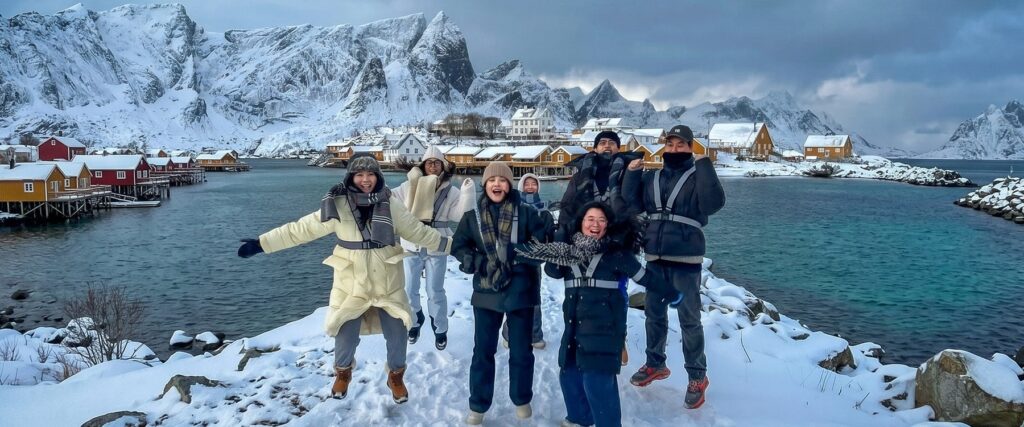
We registered NORWANA AS the same year. Our first project was running Lydersen Rorbuer in Fredvang, a small traditional accommodation, and we launched Guide to Lofoten in 2022. Today we operate three Toyota ProAce minivans, work with a small team of seasonal and on-call guides who all live in Lofoten, and run small-group (mainly winter) sightseeing tours, private year-round tours, and winter hiking tours.
Radka’s background in environmental chemistry shapes a lot of how we think about impact. Ivar didn’t finish his biology degree but probably has the stronger instinct for wildlife and ecosystems of the two of us. Neither of those things make us experts in sustainable tourism. They mean we care, we read, and we try to make decisions on something firmer than gut feeling.
We have a lot to say about overtourism in Lofoten — too much to fit on this page without losing the thread. So we’ve written a separate, detailed article that covers the housing situation, the cruise ship debate, the short-term rental market, foreign operators, the role of municipal decisions, and what we think could actually help.
If you want to understand what tourism is doing to Lofoten — and what the local and political conversation around it actually looks like — please read Overtourism in Lofoten: Is it really that bad? It is the most thorough thing we’ve written, and it’s also the most honest.
The short version: yes, by most standard definitions, Lofoten qualifies as experiencing overtourism. No, that doesn’t mean there are simply too many tourists in absolute numbers. It means the pressure on infrastructure, housing, and nature exceeds what the islands can sustainably handle at certain times and in certain places. The real problem is rarely “tourists” as a category. It’s the combination of weak public transport, unmanaged motorhome camping, cruise ship volume, the short-term rental market hollowing out year-round communities, and foreign operators running tours without paying Norwegian taxes or following Norwegian rules.
We’re a tour company. We’re part of the system we’re describing. But we live here, and we’d rather have the conversation honestly than pretend the problem doesn’t exist.
The outdoor world has gotten really good at getting people excited about specific places. Bucket lists, top hikes, hidden gems, weekend itineraries, viral viewpoints — all of it pulls more and more attention toward the same handful of locations. In recent years, hiking apps like AllTrails, Komoot, and Strava have added another layer. Every trail anyone has ever walked is now on a map. Every shortcut, every informal path, every detour someone made when the main trail was wet — much of it logged, photographed, and offered up to the next visitor as if it were a recommended route.
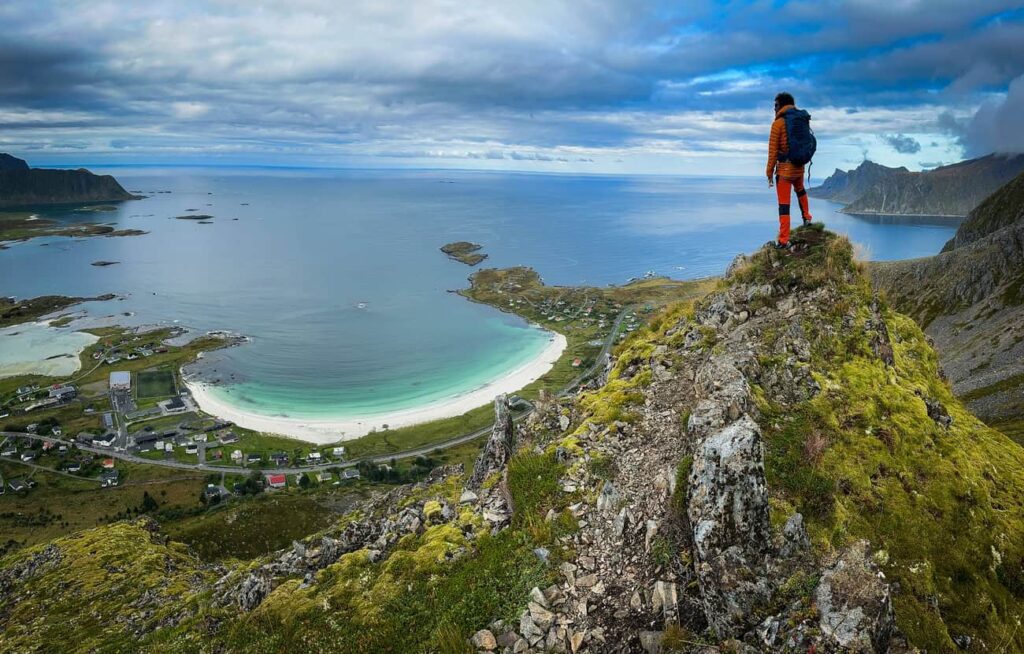
You see the effect clearly in Lofoten. Ten years ago, Reinebringen had a steep informal path used mainly by locals. Today it has a Sherpa-built staircase and a queue. Ryten, Kvalvika, Bunes beach, Offersøykammen — similar story. None of these places are bad, and the people visiting them aren’t doing anything wrong. It’s just that a small number of spots end up carrying most of the attention, while much of the rest of the islands stays quiet.
But channelling people to the quieter trails comes with its own risk — that those trails suddenly become as popular as the famous ones, without the infrastructure (parking, public toilets, hardened trail surfaces) in place to handle the traffic.
Some of what we try to do about it:
This isn’t really a problem individual tour operators can solve on their own, and we don’t think it should fall to us to decide which trails can handle traffic and which can’t. We stay in close contact with Lofotodden National Park — they’re clear about which trails in their area are fine to promote and which they’d rather shield — but the park only has authority over its own boundaries. Beyond that, it’s more of a patchwork.
Encouragingly, some of the coordination we’d like to see is already underway. Lofoten Friluftsråd, the intercommunal outdoor body for all six Lofoten municipalities, has been working on a thematic plan called Planer for friluftslivets ferdselsårer — essentially a strategy for mapping the trails across the islands, partly to serve local recreation needs and partly to channel growing tourism toward routes that are actually built to handle it.
A good example is Vestvågøy. The friluftsråd has identified specific trails that are better suited to absorbing more visitors, either because the infrastructure is already there or because upgrades are planned. The full Vestvågøy list includes Mannen, Hagskaret–Justadtinden, Smørdalskammen, Uttakleiv–Haukland, Unstad–Eggum, Haugheia, and Ballstadheia. For an operator like us, that kind of clear, official list is genuinely useful — we know which trails the local authorities want highlighted and which they want shielded, and we can plan around it.
We’d love to see the same kind of clarity for Flakstad, Moskenes, and Vågan. The Friluftsråd is already doing the work intercommunally, and the shared Friluftsforskrift adopted by all six municipalities in 2021 is a strong foundation. As far as we can tell, though, public-facing trail lists for the other municipalities aren’t as easy to find as Vestvågøy’s. We might just have missed them, in which case we’d be happy to be pointed in the right direction.
A clear, official overview from each municipality — agreed with landowners, refreshed seasonally, and published somewhere everyone can find it — would help a lot. Locals, local companies, non-local influencers, and app companies could all refer to it. And operators like us would have a framework to work within rather than relying on our own best guesses.
In the meantime, we do our best. Sometimes we get it right. Sometimes we’re probably part of the problem too.
Nothing groundbreaking. Just a series of small decisions that add up.
Our company focuses mainly on winter tourism in Lofoten, from October to April. This is a deliberate choice, and it has a lot to do with safety — both for visitors and for the people who live here.
Winter driving in Lofoten is harder than most visitors expect. Narrow roads with no shoulders, black ice, wind, long stretches of darkness, and conditions that can change within a single kilometre. Locals grow up with this. Most international visitors have never seen anything like it.
We sometimes get accused of describing winter driving in Lofoten as scary so that people will pay us for tours. That’s a fair thing to push back on, so rather than ask you to take our word for it, here are some numbers and quotes from last winter (2025–26), all from Norwegian news sources.
Two quotes from officials are worth including in full. Politistasjonssjef Ketil Finstad-Steira of the West Lofoten police described the situation to NRK as “livsfarleg køyring” — life-threatening driving. Håvard Hansen, who runs the recovery company Assistanse Nord based in Sortland, told NRK that foreign tourists in rental cars account for an estimated 70 to 75 percent of all off-road call-outs his company handles, with particular concentration on the road between Lødingen and Lofoten.
What we see on our own tours matches the news coverage. Accidents are essentially daily. Most aren’t serious — a car in a ditch, tourists standing on the roadside in the cold not knowing whom to call. But the scariest thing by far is rental cars driving on the wrong side of the road, sometimes for extended periods. We’ve called the police a few times — driving on the wrong side is treated similarly to drunk driving here — but police resources are limited and not every call gets followed up. We have read of cases where the officers confiscated the driver’s keys on the spot.
None of this is intended to scare visitors away from Lofoten. Most tourists are responsible people doing their best in conditions they’ve never seen, and the vast majority of trips go smoothly. But the pattern is real, it has been getting worse year on year, and it isn’t being solved by anyone in particular.
For visitors who don’t feel confident driving here in winter — or who’d rather not contribute another vehicle to roads that are already strained — we offer a guided alternative. Eight people travelling together in one van instead of two or three separate rental cars. A local driver who knows the road and the conditions. The option to safely visit mountains and remote viewpoints that would be genuinely dangerous to attempt alone without the right equipment, experience, and knowledge of avalanche conditions.
For the mountains specifically, the safety argument is even stronger. Norwegian search and rescue regularly responds to incidents involving unprepared visitors on winter hikes — wrong footwear, no microspikes, no understanding of avalanche risk, no plan if conditions change. Going up with a local guide isn’t just about a better experience. In winter, it’s often the difference between a good day and a serious problem.
Summer is our off-season. Most visitors can safely drive and hike on their own when the roads are dry and the daylight lasts 24 hours, so we keep things small and focus mainly on private tours rather than running at full capacity.
Skip the planning and let us show you around. Join one of these small group tours.
This story doesn’t end the way we wanted, and we think it’s worth telling honestly because the public conversation around electric vehicles in tourism rarely matches the reality on the ground in remote Arctic regions.
In 2022, Norway passed a law requiring all taxis nationwide to become emission-free, with the requirement phased in region by region. In Nordland, all taxis are required to be zero-emission vehicles from 14 June 2026. At the time the law passed, tour operators were covered by the same rules as taxis. So when we needed to expand our fleet, we did what compliant operators do: we signed leases for electric vans. Lofoten being Lofoten, the timing was tight. The vans were delivered in October 2025.
Then, with effect from 1 September 2024, Nordland introduced a separate framework for small-scale tourism operations — dispensasjon fra krav om drosjeløyve (exemption from the taxi license requirement) under yrkestransportforskriften § 48 e. Under that exemption, tour companies are no longer required to operate fully electric vehicles. We could have shrugged and ordered diesel vans the next week. Instead, we decided to actually try running the tours with the electric vans we’d just leased.
The promised range doesn’t hold up in winter. Cold weather, mountain passes, repeated stop-and-go driving, the cabin heating running for guests, and a fully loaded vehicle all eat into the range significantly. The numbers in the brochure are not the numbers we actually got on a winter day in Lofoten.
The fast-charging infrastructure isn’t ready. Lofoten has chargers, but they’re concentrated in the towns. The popular lunch stops where we’d realistically want to top up — Reine, Hamnøy, Henningsvær — don’t have fast chargers that work reliably for 9-seater vans. The chargers that do exist are often occupied by rental cars, sometimes not working at all, and the alternative is sitting in a queue.
Our guests are paying us to show them Lofoten, not to watch us charge a van. That’s not snark — it’s a basic fact about how a guided tour works. Forty minutes of charging in the middle of an 8-hour day is a meaningful chunk of the day.
Being the only compliant company would have meant a significant disadvantage. As long as other operators are running diesel without restriction, switching back to diesel ourselves was the only way to deliver the experience guests are actually paying for at a price they’re willing to pay.
So after six months of genuinely trying, we made the call to switch back to diesel for now. We managed to break the lease on one of the electric vans and replace it with a diesel under the same terms. We’re still figuring out what to do with the second electric van — we currently use it for shorter winter hiking trips where the range works, but for full-day sightseeing tours in winter, it’s just not viable yet.
We’d love to run an all-electric fleet. The technology and the infrastructure in Lofoten aren’t quite there yet for 9-seater vans on full-day winter tours. When they catch up — or when the regulation forces the entire industry to switch at the same time, removing the competitive disadvantage — we’ll be ready.
Until then, we make the choice that lets us actually deliver the tours we promise.
We love Lofoten’s wild nature, and we try not to mess it up too much. Our approach is simple: don’t leave a trace, and if possible, leave things slightly better than we found them. That means respecting local rules, adjusting plans when needed, picking up trash along the way, and taking part in local beach and underwater cleanups and dugnads.
We hold a special permit from Lofotodden National Park to run our winter group hikes to Ryten. We only run these from late October or November through April, when the ground is frozen or covered in snow. We deliberately don’t run group tours to Ryten in spring, when the vegetation is extremely fragile, or in summer, when the trail is already crowded and heavily worn. It’s not about limiting access. It’s about not adding to the damage during the months when the trail can’t recover.
For winter tours, we provide snowshoes, microspikes, hiking poles, backpacks, an outdoor sitting pad, outdoor trail food, down jackets, rain pants, gloves, buffs, and hats. Winter hiking boots are available to rent. This sounds small, but it makes a real difference in two ways.
First, it means guests don’t fly to Norway with brand-new gear they’ll use once and never again — a small but meaningful reduction in pointless consumption.
Second, when people have the right footwear, they’re much more likely to stay on the trail even when it’s wet, muddy, or slushy, rather than walking around it and creating new paths. New-path creation is exactly what tends to happen toward the end of winter, and it’s a major contributor to trail erosion.
We also run a small winter equipment rental for people who explore Lofoten on their own and don’t want to buy a full set of gear just for one trip.
None of this is perfect. But it’s a way of keeping the experience accessible while trying to limit long-term impact.
Sustainability isn’t only about nature. It’s about whether the money tourists spend in Lofoten actually stays in Lofoten — and it’s about the relationships between the people who run the businesses here.
We’ve seen what a race to the bottom looks like in other Northern Norwegian destinations. Tromsø is the cautionary tale: an arms race of operators undercutting each other, providers burning out, mental health suffering, and guests increasingly served by people who can’t afford to live in the town they’re working in. We don’t want that for Lofoten. We’re a small destination, and once that dynamic takes hold it’s very hard to reverse.
So instead of treating other local operators as competitors, we treat them as colleagues. Fremsnakke — talking each other up rather than tearing each other down — is genuinely how we try to behave. When a guest asks us about a kayaking trip, we send them to people we trust. When a kayaking company has a guest asking about transport or hiking, they send them to us. When somebody asks about photography, we send them to a local photographer rather than recommending we do it ourselves. That kind of network is the actual infrastructure of a sustainable destination.
A few of the local businesses we regularly send guests to, and who we’d happily recommend:
Transport and water-based:
Accommodation:
Food:
Local creatives:
We consistently choose local companies over bigger chains, and we only work with operators whose licenses, insurance, and approvals are properly in order. This matters more than it sounds, especially for boat tours and photography workshops. For the longer version of why, see our guide to running tours legally in Lofoten and Norway.
We list our tours on GetYourGuide and Viator. They send us valuable bookings, and we acknowledge that. But we’d much rather you booked directly with us, or with any other local operator.
These platforms are giant international corporations. They take a meaningful cut of every booking — money that would otherwise stay in the local economy. They add a layer between the guest and the operator that often makes communication harder, especially when something needs to change. They make the operator–guest relationship transactional in a way that doesn’t match how small local businesses actually work. And they actively push price competition, which is exactly the dynamic that has damaged the operator landscape in Tromsø.
If you want to be the kind of tourist who actually supports the destination you’re visiting: book directly. With us, with any of the operators above, with whoever runs the experience you want to have. Cut the platform out. Your money stays in Lofoten. The operator can plan properly. Everybody wins except the platform, and the platform will be fine.
Sustainability is also about sharing knowledge — and being honest about what we know.
Through our Guide to Lofoten blog, we publish practical articles aimed at helping visitors travel better here, whether they’re booking with us or planning entirely on their own. The articles we’ve put the most work into:
We don’t write these articles to drive bookings. We write them because the information should exist somewhere accessible, and because the more visitors understand Lofoten before they arrive, the better the trip tends to go — for them, for locals, and for the places themselves.
We’re part of a few local networks and organisations.
Reinebringen Network — a group of around 16 local businesses (founded in 2025) working together to share accurate information about the Reinebringen hike and to encourage more responsible behaviour in the area. They also run a small initiative where part of souvenir sales goes back into local projects.
LoVe Utvikling — the sustainable business development network for Lofoten and Vesterålen. We’re a paying member and an active contributor — currently working on a project to create a shared photo bank for the Lofoten region, so smaller local businesses have access to high-quality regional imagery without paying stock-photo fees.
Visit Lofoten — we’re paying members, which mostly means contributing to the regional destination management work.
Local dugnads — we regularly take part in dugnads (volunteer community workdays) for trail marking and clean-ups.
In practice, all of this mostly means staying connected, sharing information, and sitting through long meetings.
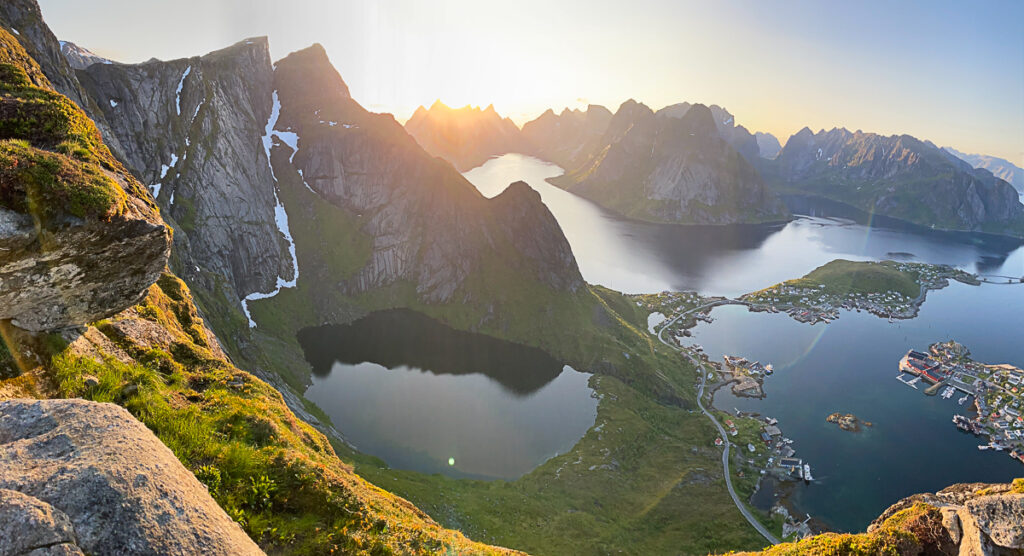
And sometimes it also means speaking up. When projects come up that don’t make sense to us — like the recent plans for a fish farm in Reinefjorden — we raise our voices. The fish farm proposal is still ongoing. Nothing dramatic. Just not staying quiet.
We get a version of this question — usually phrased less politely — from a small but vocal group of locals: aren’t you just parasiting on Lofoten’s nature like any other tour company?
It’s a fair thing to ask, and it deserves a real answer rather than a defensive one.
You make money off the place we live in. You bring more tourists. You contribute to the pressure on roads, parking, housing, nature, and the everyday quality of life. You’re part of the industry that’s changing Lofoten into something we don’t recognise.
We’re part of the community here:
We reduce the harm that visitors can do:
We say no to things we shouldn’t be doing:
We speak up:
We hear you. There is a real problem with tourism in Lofoten. But it has so many layers.
Not every tourist is the same. We meet people whose respect for the place is humbling. We also meet the people who pitch tents on local cemeteries. (Yes, that actually happened.) Same goes for locals — there are people with whom we have honest, useful conversations about all of this, and there are the louder voices for whom no answer would ever be acceptable. Same goes for tour companies. There are operators who think sustainability matters more than maximising profit and doubling turnover every year, and there are operators who don’t. We try hard to be in the first group, and we know we’re not the only ones.
Nothing about this is black and white. We’re happy to talk, listen, change our minds where we should, and admit where we fall short. But just as some of you are tired of “tourists in Lofoten” as a category, we’re tired of the personal hostility that sometimes gets directed at us — and at every other local operator trying to do this carefully.
We’re happy to have the conversation. We refuse to be a target for a problem we didn’t create alone and can’t solve alone.
Because we run small private tours rather than large bus tours, and because we operate fully legally in Norway — licensed transport, proper insurance, properly employed local guides, and all the paperwork that comes with running a legitimate Norwegian company. Many foreign workshops and operators running in Lofoten today don’t operate legally. They don’t have transport permits, their guides don’t have the required driver approvals, and they don’t pay Norwegian taxes. That lets them charge less. We’ve written about the full legal situation in our guide to running tours legally in Lofoten and Norway.
Same reason. Foreign workshops that include transport in Lofoten without the right Norwegian permits operate at significantly lower costs because they’re skipping the regulatory framework — until they get caught. Roadside checks during winter 2025–26 became regular. Fines can reach around 70,000 NOK and operators are required to stop on the spot. Our pricing reflects the cost of doing this properly.
Tipping isn’t expected. We pay our guides well, and the Norwegian model assumes proper wages rather than tip-based income. If you want to do something for a guide who made your day, the most useful thing you can do is leave them a 5-star review by name. Our guides receive bonuses for each 5-star review they’re mentioned in, so writing about how great they were is genuinely the best way to thank them.
Possibly — and we’d rather you ask us than assume not. We don’t get many enquiries specifically about wheelchair access, but we do regularly take guests with various mobility limitations. Both of us worked as personal assistants for a wheelchair-user client for years before moving to Lofoten, so we have hands-on experience reading terrain, recognising when someone needs a hand, and adapting plans on the day. Lofoten itself is not the most accessible destination, but our small-group setup means we can usually find a version of the experience that works.
Absolutely. Small-group tours are often a great option for solo travellers, because the group size makes it easier to actually meet people and the day has natural pauses where conversation happens.
Book directly if you want to be a tourist who actually supports the destination. GetYourGuide and Viator are giant international corporations that take a meaningful cut, add an extra link in the communication chain, and actively push price competition that damages the operator landscape (Tromsø is the example of where this leads). They serve a purpose — they help guests find us who otherwise wouldn’t — but every direct booking keeps more money in Lofoten and makes the operator–guest relationship work the way it should.
Short version: we tried for six months, the technology and infrastructure in Lofoten aren’t ready for 9-seater vans on full-day winter tours, and the regulation that originally required electric vehicles was relaxed for tour operators in September 2024. See the full section above for the detailed story.
Share this post

Hi! We are Ivar & Radka, an international couple who runs the Guide to Lofoten. More about us
Most popular posts
Other popular posts

Comments
Our small group tours take you beyond the guidebook. To hidden beaches, dramatic fjords, and mountain views most visitors never find. Pick a tour and we’ll take care of the rest.
5.0 (160+ reviews)
This website uses cookies to provide its services. By using this website, you agree to the use of cookies.