160+ reviews
Yes, travel insurance is worth it for a Lofoten or northern Norway trip, more so than for most destinations, and it comes down to one simple fact: you’re travelling to a small group of remote islands in the North Atlantic, and the further north you go in Norway, the more that matters.
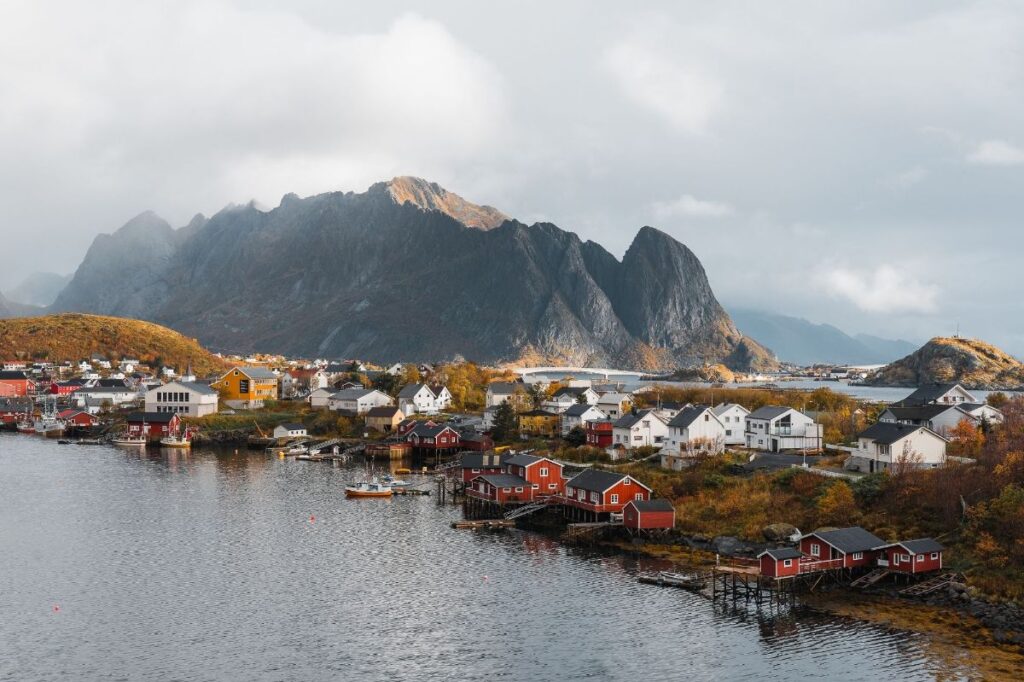
The whole Lofoten archipelago has around 25,000 inhabitants, spread across six islands. Once you reach the westernmost islands still connected by road, Moskenes and Flakstad, that number drops to roughly 2,000 people. Buses don’t run every hour, there’s no fleet of taxis waiting to reroute you, and most tourist businesses out here are small and seasonal. That’s exactly why remoteness and insurance go together: when a ferry or flight falls through, there’s very little backup to improvise with, so whether you have proper cover ends up mattering a lot more here than it would somewhere with three alternative flights a day.
This isn’t only a Lofoten problem, either. Most of what’s below applies just as much to Senja, Vesterålen, or anywhere else in northern Norway. We’re using Lofoten as the example because it’s where we live and work, but the underlying issue, remoteness plus weather, is the same across the whole north.
We’ve worked in the tourism sector in Norway for years now, running hostels and hotels, doing sales and customer support for a tour agency, and now running our own private sightseeing and hiking tours. And every single time the weather turns bad, we get the same messages.
“I can’t get to your hotel/activity because…” and then insert a reason completely out of anyone’s control: the cruise ship didn’t dock, there’s an avalanche on the road, the tunnel is closed, the flight got cancelled. “…so, can I get a refund?”
We do feel for you. Genuinely. But we also want you to understand what’s actually happening here, before it happens to you.
Lofoten islands stick straight out into the Atlantic Ocean, so like Iceland or the Faroe Islands, we sit fully exposed to the low-pressure systems rolling in off the sea. That means storms. Often.
You don’t need to imagine an Alpine-style storm here, the kind that builds up on a hot afternoon and rolls through with rain and lightning. We barely get lightning in Lofoten, if ever. What we get instead is wind. Properly crazy wind.
Wind strong enough that you can struggle to open your own front door. Wind that has the local meteorologist issuing public warnings to tie down your trash bins and trampolines. Wind that takes down power lines and leaves you suddenly without electricity.
And even if you follow the weather forecast and tie down the trampolines, sometimes that isn’t enough. We had our own trash bins tied down, fenced on three sides, weighed down with heavy stones on the lid, and we still spent days searching for it afterwards. We’ve had parts of our roof and our own front door ripped clean off their hinges and sent flying toward the neighbours.
These storms don’t just pass through in an afternoon either. If we’re lucky, they do. If we’re not, they can sit over the islands for days. Days when the Bodø-Moskenes ferry is cancelled. Days when flights don’t go, and when there finally is a window, the plane is overbooked because it has to squeeze in everyone from the cancelled flights before it. And days when the weather on land is perfectly fine, but a cruise ship decides the wind and waves offshore are too much for tendering, and skips the port entirely.
Put the remoteness of Lofoten and the unpredictable weather together, and it becomes very easy for something like this to happen to you:
None of these are anyone’s fault. They’re not your fault, and they’re not the fault of the hotel or tour company waiting for you either.
Before we even get to insurance, there’s something you can do yourself that costs nothing and solves half the problem: give your trip some breathing room.
Don’t book a tour or activity on the same day, or even the same evening, you’re arriving in Lofoten. And honestly, think twice about the day after too. Give yourself time to adjust, and give your own travel plans a buffer, because they might not run perfectly smoothly. Something might be late, cancelled, or rerouted at some point on a trip up here. That’s just how it goes.
If you’re flying back home from Bodø and catching the Bodø-Moskenes ferry, come to Bodø a day early. Don’t cut it fine on the same day you land. A delayed flight or a bad connection can wreck the whole plan if there’s no slack in it.
As a tour provider, we can also give you a certain amount of flexibility ourselves. If we have spare capacity, or if you’ve booked a private tour with us and one of our guides is free, we’re often happy to reschedule you, offer a discount, or find some other way to make it work.
But that’s only possible if there’s room to work with. If every single day of your trip is booked solid, or if you’re visiting on a cruise ship with just that one day ashore, there’s nothing left for us to shift around, and no way around losing that day.
Every company sets its own cancellation policy. Before the pandemic, it was fairly normal to ask for a week’s notice, sometimes three days. These days, platforms like GetYourGuide, Viator, and Booking.com push everyone toward a 24-hour cancellation window, something that was introduced to give travellers flexibility during Covid and, for whatever reason, just stuck around after the pandemic ended.
So within that 24-hour window, you can generally cancel for free. Even that is hard on a family-owned boutique hotel or a small tour operator like us, because we rarely manage to fill your spot on such short notice.
But once you’re past that 24-hour mark, that’s where things get genuinely difficult, and I really want to explain this properly, because I want you to understand it.
We completely accept that it isn’t your fault the ship didn’t dock, or your flight landed late, or got cancelled outright. But you also need to understand that it isn’t our fault either, and it’s not fair to ask a small local business to absorb that cost. When you book a tour with us, our guide is ready to go. We can’t call up our guide on the morning and say, “Sorry, our guests didn’t land today, go home, we’ve got no work for you,” and expect him/her to just find something else with less than a day’s notice. That’s someone’s income.
So who’s actually to blame when this happens? Nobody, really. It’s the weather. The road conditions. But the weather isn’t going to refund your money.
Skip the planning and let us show you around. Join one of these small group tours.
This is exactly the gap travel insurance is meant to fill, and in Lofoten, and northern Norway generally, it earns its cost more than in most other destinations.
A few things worth actually checking in your policy before you travel here, rather than assuming a generic policy will cover it:
Trip delay and missed connection cover
Look for coverage that kicks in when a flight, ferry, or bus delay (not just a full cancellation) causes you to miss a connecting booking, an accommodation night, or an activity. This is the exact situation that plays out here constantly: the Bodø-Moskenes ferry gets cancelled, and suddenly your onward flight, your hotel, and your tour are all at risk.
“Acts of nature” or weather-related cancellation cover
Some policies explicitly cover cancellations caused by severe weather, others only cover a narrower list of reasons. Read the actual wording.
Trip interruption (also called travel interruption), not just trip cancellation
Cancellation cover protects you if you can’t start your trip. Interruption cover protects you when something goes wrong partway through it, which is usually the more relevant scenario in Lofoten, since you’re more likely to lose a day or two mid-trip than to never make it here at all.
A “cancel for any reason” option, if it fits your budget
This tends to be pricier and isn’t necessary for everyone, but if your trip depends on tight connections through a place like Bodø or Evenes, it can be worth the extra cost.
Adventure activity cover, if you’re hiking
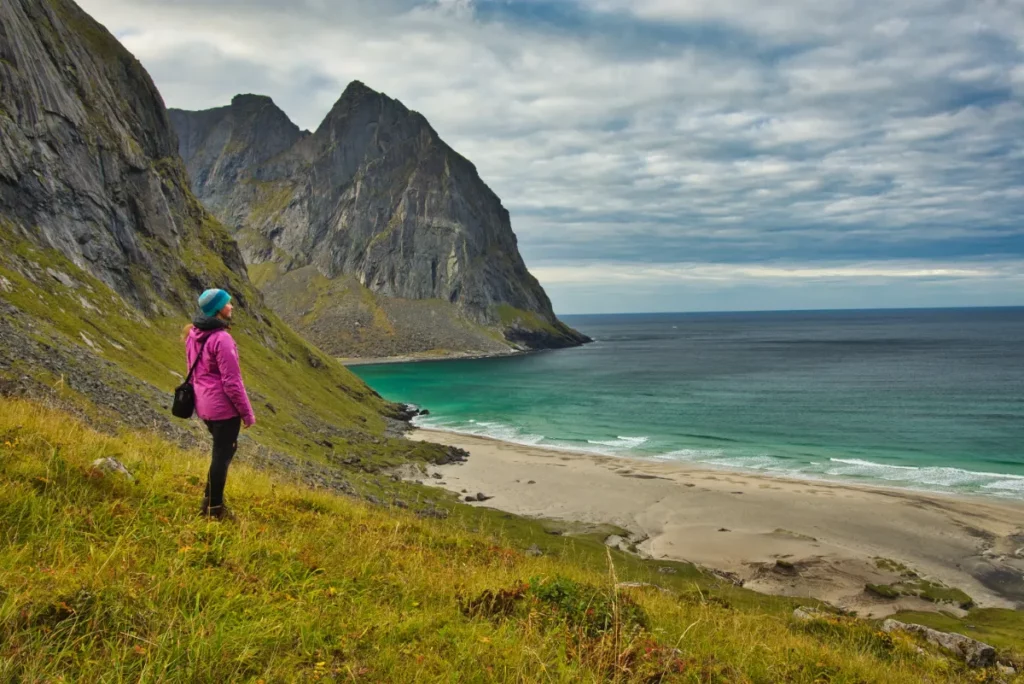
If your trip includes hikes like Reinebringen, Ryten, or Munkebu, check that your policy actually covers hiking and doesn’t quietly exclude it as an “adventure sport.” Some budget policies do.
If you’re arriving in Lofoten by cruise ship rather than flying in independently, the calculus is a bit different: a missed embarkation, a skipped port call like Gravdal, or an unused prepaid shore excursion matter more than the kind of general policy most comparisons focus on.
These are illustrative examples and vary heavily by age, trip cost, and exact plan tier, so always get a live quote directly from the provider before deciding. Prices checked in September 2026.
| Travel Guard (AIG) — US | Cover-More — Australia | Allianz Travel — Asia | AXA — Europe | |
| Best fit | US-based cruise travellers | Australian-based cruise travellers | Travellers from Singapore, Hong Kong, or mainland China | European cruise travellers |
| Pre-departure trip cancellation | Up to $30,000 on higher tiers (Preferred/Deluxe), with a Cancel For Any Reason add-on reimbursing up to 75% | Cancellation cover is chosen by you at quote time, scaling to your actual prepaid costs | Varies by tier and country of purchase, typically several thousand dollars-equivalent on mid-to-higher tiers | Roughly £1,500–£5,000 depending on tier (UK figures shown; other European markets vary) |
| Trip interruption | Included, same structure as cancellation | Included on Comprehensive and Comprehensive+ tiers | Included | Included, with travel disruption cover up to £5,000 on the top tier |
| Cruise-specific coverage | Genuine cruise-specific plans with missed-departure and missed-port wording built in, not a generic add-on | Dedicated Cruise Cover add-on: missed port up to $1,000, cabin confinement up to $1,500, missed shore excursions up to $1,000 | Varies; confirm the policy explicitly names cruise cover rather than a generic land-trip add-on | Cruise add-on available on most tiers; confirm missed-port wording specifically rather than assuming it’s included |
| Approx. starting price | Varies widely by trip cost and age; the Essential tier runs notably cheaper than Preferred or Deluxe | Price scales with however much cancellation cover you choose, so there’s no single starting figure | Varies significantly by which country you’re buying from | From roughly £25–£40 for a short single trip on the entry tier, more once cruise cover is added |
| Buy after you’ve already left? | No | No | No | No |
A few honest notes on top of the table:
And to be clear: these are just our recommendations, not the only options. Feel free to look into your own country’s traditional travel insurance, or check what’s already included with your credit card if you booked flights on it.
Whatever you go with, just make sure it actually covers trip cancellation and trip interruption, not only emergency medical, since that’s the part that matters most for the kind of weather delays we’ve been talking about in this article.
We’re not insurance brokers, and this isn’t financial advice, just years of watching the same weather patterns cause the same problems for our guests. Before you buy a policy, read the actual terms, not just the headline, and ask specifically about weather-related delays and cancellations for remote regions.
If you’re an EU or EEA citizen, your blue European Health Insurance Card (EHIC) should, in theory, be enough to cover emergency medical treatment in Norway on the same terms as a Norwegian citizen.
In practice, we’d still strongly recommend getting proper travel insurance on top of it. The blue card covers necessary public healthcare, but it doesn’t cover things like medical evacuation, repatriation, or a hospital stay that drags on longer than expected, and if you’re out in western Lofoten, “necessary treatment” can mean a much longer and more complicated journey than it would back home.
Here’s something not many visitors know: search and rescue in Norway, including helicopter rescues, is free. We’re not telling you this so you go looking for an excuse to use it. We’re telling you so that if you genuinely need it, you don’t hesitate to call.
Last year we ran into a young Polish couple who’d injured a leg descending the steep, muddy path off Tindstinden. It took us ages to convince them to let us call for rescue, because they weren’t sure their insurance actually covered a helicopter, and they were worried about the cost if it didn’t. That hesitation is exactly the problem. Please don’t be the person weighing up a bill while sitting on a mountainside with a busted leg and the weather closing in. Call 113. The rescue itself won’t cost you anything.
That said, “the rescue is free” isn’t the whole story. Once you’re off the mountain, the hospital treatment, any follow-up care, or a flight home if you’re not fit to travel commercially- that’s where costs can add up fast for anyone without proper insurance, EU/EEA card or not. So think of it less as “we don’t need insurance because rescue is free” and more as “the free rescue gets you to help; the insurance is what covers everything after that.”
113 is for life-threatening emergencies only. Someone unconscious, not breathing, severe bleeding, a major accident. That’s what it’s there for.
For most illnesses or injuries that aren’t life-threatening, like a bad fever, a suspected fracture, a deep cut that needs stitches, or a stomach bug that won’t quit, you call legevakt instead.
Legevakt is the Norwegian out-of-hours emergency clinic, basically a walk-in medical service for anything urgent that can’t wait for a regular doctor’s appointment but isn’t a 113 situation either. They’ll assess what you’re describing over the phone and tell you what to do next: come in, stay put, or, in serious cases, they’ll be the ones who call an ambulance for you.
The general national number is 116117, but it can be tricky to get through on it from a foreign phone number.
The international number should be: +47 97 99 79 99
If those numbers do not work for you, your best bet is to just google “legevakt” plus the nearest bigger town, like “legevakt Leknes” or “legevakt Svolvær” if you’re in Lofoten, and it’ll pull up the right local number and address.
For reference:
One more thing that surprises a lot of visitors: ambulances here aren’t a transport service to and from the hospital. If you break a leg and you’re stable, don’t be surprised if you’re told to get yourself to the hospital by taxi or private car instead of waiting for an ambulance. Ambulances in a place like Lofoten are stationed to be ready for genuinely serious situations, so they’re kept free for that, not for transport that isn’t urgent.
It’s also part of why local taxis can be hard to book months or even weeks ahead for ordinary tourist transport, and why they sometimes run late or feel scarce when you do get one: in a lot of small communities in Norway, the same taxis double as the patient transport service, ferrying non-emergency patients to appointments and between health facilities. When a taxi is out on one of those runs, it isn’t available for your airport pickup, booked in advance or not.
Lofoten, and northern Norway more broadly, is genuinely one of the most beautiful places either of us has ever lived, and we’re not writing this to scare you off. We’re writing it so that when the wind picks up and your ferry gets cancelled, you’re not caught off guard, financially or otherwise. Get proper travel insurance, read what it actually covers, save 113 and legevakt’s number before you head out, build a bit of slack into your itinerary, and you’ll be in a much better position to just shrug, adjust your plans, and enjoy the extra day on the islands.
It depends on the policy. Some plans explicitly cover cancellations and delays caused by severe weather under an “acts of nature” clause, while others only cover a narrower list of specific reasons. Always read the actual policy wording, not just the summary, before assuming weather is covered.
Yes, including helicopter rescues. This covers the rescue itself, getting you off a mountain or out of danger. It doesn’t cover what happens afterward, like hospital treatment, follow-up care, or a flight home if you’re not fit to travel, which is where travel insurance still matters.
We’d still recommend it. The EHIC covers necessary public healthcare for EU/EEA citizens in Norway, but it doesn’t cover medical evacuation, repatriation, or an extended hospital stay, all of which are more likely to matter in a remote area like Lofoten.
Trip cancellation covers you if you have to cancel before your trip even starts. Trip interruption covers you if something goes wrong partway through, like a cancelled ferry stranding you mid-trip. In Lofoten, interruption is usually the more relevant one, since a full trip cancellation is less common than losing a day or two along the way.
Call 113 only for life-threatening emergencies. For anything urgent but not life-threatening, like a suspected fracture or a bad fever, call legevakt on 116117, or search “legevakt Leknes” or “legevakt Svolvær” if the national number is hard to reach from a foreign phone.
Not necessarily. Ambulances here are kept available for genuinely serious situations, so if you’re stable, you may be asked to get to the hospital by taxi or private car instead.
Share this post

Hi! We are Ivar & Radka, an international couple who runs the Guide to Lofoten. More about us
Most popular posts
Other popular posts

Comments
Our small group tours take you beyond the guidebook. To hidden beaches, dramatic fjords, and mountain views most visitors never find. Pick a tour and we’ll take care of the rest.
5.0 (160+ reviews)

This website uses cookies to provide its services. By using this website, you agree to the use of cookies.